




 Home
 News
 Colleges




 Courses
 Admission
 Lectures
 Online Test
 Past Papers
 Date Sheets
 Results
 Study Abroad
 Jobs
 Tutors
 More


 Apps





MCQ's Test For ECAT Chemistry Chapter 11 Reaction Kinetics
Try The MCQ's Test For ECAT Chemistry Chapter 11 Reaction Kinetics
-
Total Questions30
-
Time Allowed30
ECAT Chemistry Chapter 11 Reaction Kinetics
00:00

Question # 1

Question # 2
The rate of reaction is denoted by
Question # 3
The factor which effect the rate of reaction
Question # 4
In the rate equation when the concentration of reactants are unity, then rate is equal to
Question # 5
The number of atoms or molecules whose concentrations determine the rate of the reaction is called
Question # 6
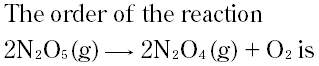
Question # 7
The unit of the rate constant is the same as that of rate of reaction in :
Question # 8
It is common observation that rates of chemical reactions differ :
Question # 9
When copper is allowed to react with HNO3, the reaction is slow in the beginning, finally becomes very fast. It is due to the formation of an auto catalyst which is
Question # 10

Question # 11
The rate of reaction :
Question # 12
Homogenous catalysis is that in which catalyst and reactants are in same phase. Which one of the following reaction is a homogenous catalysis
Question # 13
The rate equation for a reaction is Rate =k[A]. what are unit of K ?
Question # 14
The rate of reaction b/w two specific time intervals is called :
Question # 15
With increases in temperature of 10 K of the reacting gases the rate of reaction is doubled because
Question # 16

Question # 17
Dilatometric method is used for rate determination when
Question # 18
All reactions occur in :
Question # 19
The experimental relationship between a reaction rate and the concentration of reactants is called
Question # 20

Question # 21
For effective collisions the molecules slow down before collision and their kinetic energy decreases which results in increase in their
Question # 22
In exothermic reaction decrease in potential energy of the products will result in
Question # 23
By the use of catalysis the energy of activation is
Question # 24
In the manufacture of NH3by Haber's process catalyst used is iron its catalytic efficiency is poisoned by
Question # 25

Question # 26
Platinum is poisoned by
Question # 27
With the progressive of the reaction the slope of the curve between concentration of product and time
Question # 28
If the rate of decay of radioactive isotope decreases from 200 cpm to 25 cpm after 24 hours, what is its half life :
Question # 29
The experimental relationship between a reaction rate and the concentration of reactants is known as
Question # 30
Which of the following factors does not influenced the rate of reaction





Top Scorers Of ECAT Chemistry Chapter 11 Reaction Kinetics MCQ`s Test
-
A Abubakar basra 02 - Mar - 2024 05 Min 25 Sec 120/120 -
T Tanzeel Ur Rehman 29 - May - 2024 06 Min 39 Sec 115/120 -
M M Umer Arain 10 - Nov - 2024 00 Min 12 Sec 105/120 -
U Unaiza Usman 23 - Feb - 2024 04 Min 37 Sec 100/120 -
H Huzaifa Asim 28 - May - 2024 01 Min 53 Sec 95/120 -
G GOVT. SUFFA EDUCATION CENTER GIRLS MURIDKE 30 - May - 2024 05 Min 44 Sec 90/120 -
H Haseeb Ahmed 25 - Feb - 2024 10 Min 22 Sec 85/120 -
C Computer mail 31 - Mar - 2026 07 Min 26 Sec 84/120 -
B Bilawal Amjad 05 - Mar - 2024 23 Min 27 Sec 80/120 -
M Maryam Fatima 19 - Mar - 2024 05 Min 45 Sec 75/120 -
M Mustaqeem 28 - Feb - 2024 11 Min 57 Sec 75/120 -
T Tamshi Sohail 22 - Apr - 2024 20 Min 02 Sec 75/120 -
S Shazi Ansari 06 - Jun - 2024 01 Min 59 Sec 70/120 -
M Muntasir Khokhar 21 - May - 2024 06 Min 02 Sec 70/120 -
U uzma majeed 11 - Mar - 2024 06 Min 47 Sec 65/120
ECAT Chemistry Chapter 11 Important MCQ's
| Sr.# | Question | Answer |
|---|---|---|
| 1 | Refrectrometric method is used when |
A. Reactions involving absorption of I.R. or U. V
B. Reactions involving change of refractive index
C. Reactions involving ions
D. Change of optical activity
|
| 2 |
A pseudo uni-molecular reaction has order of reaction : |
A. 3
B. 2
C. 1
D. 0
|
| 3 | The unit of the rate constant is the same as that of rate of reaction in : |
A. Third order reaction
B. Second order reaction
C. First order reaction
D. Zero order reaction
|
| 4 | In zero order reaction, the rate is independent of : |
A. Temperature of reaction
B. Concentration ofreactants
C. Concentration of products
D. None of these.
|
| 5 | The rate of reaction is denoted by |
A. dc/dp
B. dc/ac
C. dc/dT
D. dc/dt
|
| 6 | If half life period of a reaction is independent of the concentration of the reactants, then the reaction is |
A. Zero order
B. First order
C. Second order
D. Order is in fraction
|
| 7 | Group l-A elements react with water fastly than the reaction of group ll-A elements because |
A. lAelements are more soft then llA
B. lAelements are non-metals
C. lAelements have 1 electron in their outermost s-orbital and are strongly electropositive
D. lAelements make ionic bond
|
| 8 | If a reactant or product of a reaction absorbs radiation, then physical method for determining the rate of reaction is |
A. Spectrometry
B. Refractometry
C. Conductivity measurement
D. Optical method
|
| 9 | The rate of reaction b/w two specific time intervals is called : |
A. Instantaneous rate of reaction.
B. Average rate of reaction.
C. Rate of a reaction.
D. Minimum rate of a reaction.
|
| 10 |

|
A. Measuring pH
B. Measuring density
C. Titration against standard NaOH
D. Titration against standard KMnO4solution
|

Test Questions
Share your comments & questions here
No comments yet. Be the first to comment!