




 Home
 News
 Colleges




 Courses
 Admission
 Lectures
 Online Test
 Past Papers
 Date Sheets
 Results
 Study Abroad
 Jobs
 Tutors
 More


 Apps





MCQ's Test For ECAT Chemistry Chapter 8 Chemical Equilibrium
Try The MCQ's Test For ECAT Chemistry Chapter 8 Chemical Equilibrium
-
Total Questions30
-
Time Allowed30
ECAT Chemistry Chapter 8 Chemical Equilibrium
00:00

Question # 1
What happens when reaction is at equilibrium and more reactant is added :
Question # 2
Which of the following favours the reverse reaction in chemical equilibrium?
Question # 3
pKb value of NH4OH is 4.74. If the concentration of NH4OH is 1 molar containing 0.1 molar NH4Cl, then pH of this buffer will be
Question # 4
The substance which increases rate of reaction but remains unchanged at the end of reaction is called :
Question # 5
The solubility product of AgCl is 2.0 x 10⁻¹⁰mol2dm-6The maximum concentration of Ag+ions in the solution is
Question # 6
Buffers having pH less than 7 are made
Question # 7
Which of the following factors will favour the reverse reaction in a chemical equilibrium?
Question # 8
N23H2⇌ 2NH3
Which of the following change will favorthe formation of moreNH3at equilibrium in above reaction :
Question # 9
The rate at which a substance reacts is directly proportional to its active mass and the rate of reaction is directly proportional to the product of the active masses of reacting substances, is called
Question # 10
A large value of Kcmeans that at equilibrium :
Question # 11
The rate of which the reaction proceeds is directly proportional to the product of the active masses of the reactants is according to
Question # 12
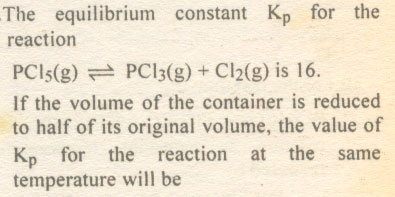
Question # 13

Question # 14
Two moles of HI was heated in a sealed tube at 440°C till the equilibrium was reached. HI was found to be 22% decomposed. The equilibrium constant for dissociation is
Question # 15
Acetic acid is 1.33% ionized, In 1000 molecules of 0.1 M acetic acid the number of H+ions is
Question # 16
The value of Kpis greater than Kcfor a gaseous reaction when
Question # 17
According to Le-Chatelier's principal, adding heat to a solid and liquid in equilibrium will cause the
Question # 18
A buffer solution of 0.1 molar HCOOH and 0.1 molar HCCONa has pH = 3.78 To is 0.01 molar HCl is added, then pH of the buffer solution becomes
Question # 19
For what value ofKc almost forward reaction is complete :
Question # 20

Question # 21

Question # 22
Kbvalue of NH4OH is 1.81 x 10⁻⁵and its conjugate acid has Ka= 5.7 x 10⁻¹⁰pKb of the base is 4.74, pKa of its conjugate acid is
Question # 23
The solubility product of Ca(OH)2is 6.5 x 10⁻⁶. The concentration of OH-ions is
Question # 24
When the rate of formation of reactants is equal to the rate of formation of products, this is known as
Question # 25
0.1 MHCI has pH = 1.0, it is about 100 times stronger than acetic acid. Then pH of acetic acid will be
Question # 26
For which system does the equilibrium constant, KC has units of concentration
Question # 27

Question # 28
N2 +3H2⇌
2NH3 + Heat for above equation, the
Question # 29
N2O4⇌
2NO2
For the above reaction, which of the Following expression of
Kc correct :
Question # 30
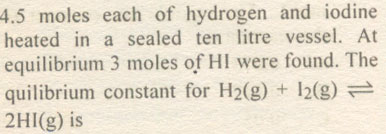





Top Scorers Of ECAT Chemistry Chapter 8 Chemical Equilibrium MCQ`s Test
-
A Arian Ahmed 06 - Mar - 2024 00 Min 04 Sec 115/120 -
H Huzaifa Asim 28 - May - 2024 01 Min 12 Sec 115/120 -
M Muneeb Aslam 03 - Jun - 2024 09 Min 57 Sec 105/120 -
? ?GøÐ øf ?ë??h? 29 - May - 2024 32 Min 31 Sec 95/120 -
H Hamza Malhi 10 - Mar - 2024 14 Min 42 Sec 85/120 -
F Furqan Asif 20 - Mar - 2026 95 Min 59 Sec 84/120 -
M Maryam Fatima 19 - Mar - 2024 09 Min 42 Sec 80/120 -
F Fatima Tabassum 16 - Jan - 2025 09 Min 48 Sec 65/120 -
E Essa raza 22 - Jun - 2024 09 Min 07 Sec 55/120 -
K kayani 21 - Jul - 2024 09 Min 41 Sec 55/120 -
T Tamshi Sohail 20 - Apr - 2024 23 Min 19 Sec 55/120 -
R random 11 - May - 2024 06 Min 15 Sec 50/120 -
H Haniya Ali 14 - Mar - 2024 14 Min 41 Sec 50/120 -
E Ezzah Ansari 15 - May - 2024 15 Min 25 Sec 50/120 -
M Meena 19 - Apr - 2024 10 Min 19 Sec 45/120
ECAT Chemistry Chapter 8 Important MCQ's
| Sr.# | Question | Answer |
|---|---|---|
| 1 |

|
A. 1
B. 10
C. 5
D. 0.33
|
| 2 | The rate at which a substance reacts is directly proportional to its active mass and the rate of reaction is directly proportional to the product of the active masses of reacting substances, is called |
A. Law of conservation of energy
B. Le-Chateliers principle
C. Law of mass action
D. None of these
|
| 3 | Ifkcof a reaction productis verylarge, it indicates that equilibrium occurs : |
A. With the help of a catalyst.
B. With no forward reaction.
C. At a low product concentration.
D. At a high product concentration.
|
| 4 | I a chemical reaction equilibrium is said to have been established when : |
A. Rate of opposing reactions are equal.
B. Rate constants of opposing reactions are equal.
C. Opposing reactions stop.
D. Concentration of reactants and products are equal
|
| 5 |

|
A. Increase in concentration of 1
B. Decrease in concentration of I2
C. Increase in temperature
D. Increase in total pressure
|
| 6 | Reactions that proceed on both sides and never go to completion are called |
A. Irreversible reactions
B. Reversible reactions
C. Opposing reactions
D. Spontaneous reactions
|
| 7 |

|
A. Kp> Kc
B. Kc> Kp
C. Kp= Kc
D. None of these
|
| 8 |
N2 + O2 ⇌2NO The unit of Kc for tis reaction will be: |
A.
No unit
B.
mol-2 dm-3
C.
mol-1 dm-3
D.
mol-2 dm+3 |
| 9 | 1 mole of N2and 2 moles of H2are allowed to react in a 1 dm3vessel. At equilibrium 0.8 mole of NH3is formed. The concentration of H2in the vessel is |
A. 0.6 mole
B. 0.8 mole
C. 0.2 mole
D. 0.4 mole
|
| 10 | When H2and I2are mixed and equilibrium is attained, then |
A. Amount of HI formed is equal to the amount of H2dissociated
B. HI dissociation stops
C. The reaction stops completely
D. None of these
|

Test Questions
Share your comments & questions here
No comments yet. Be the first to comment!